

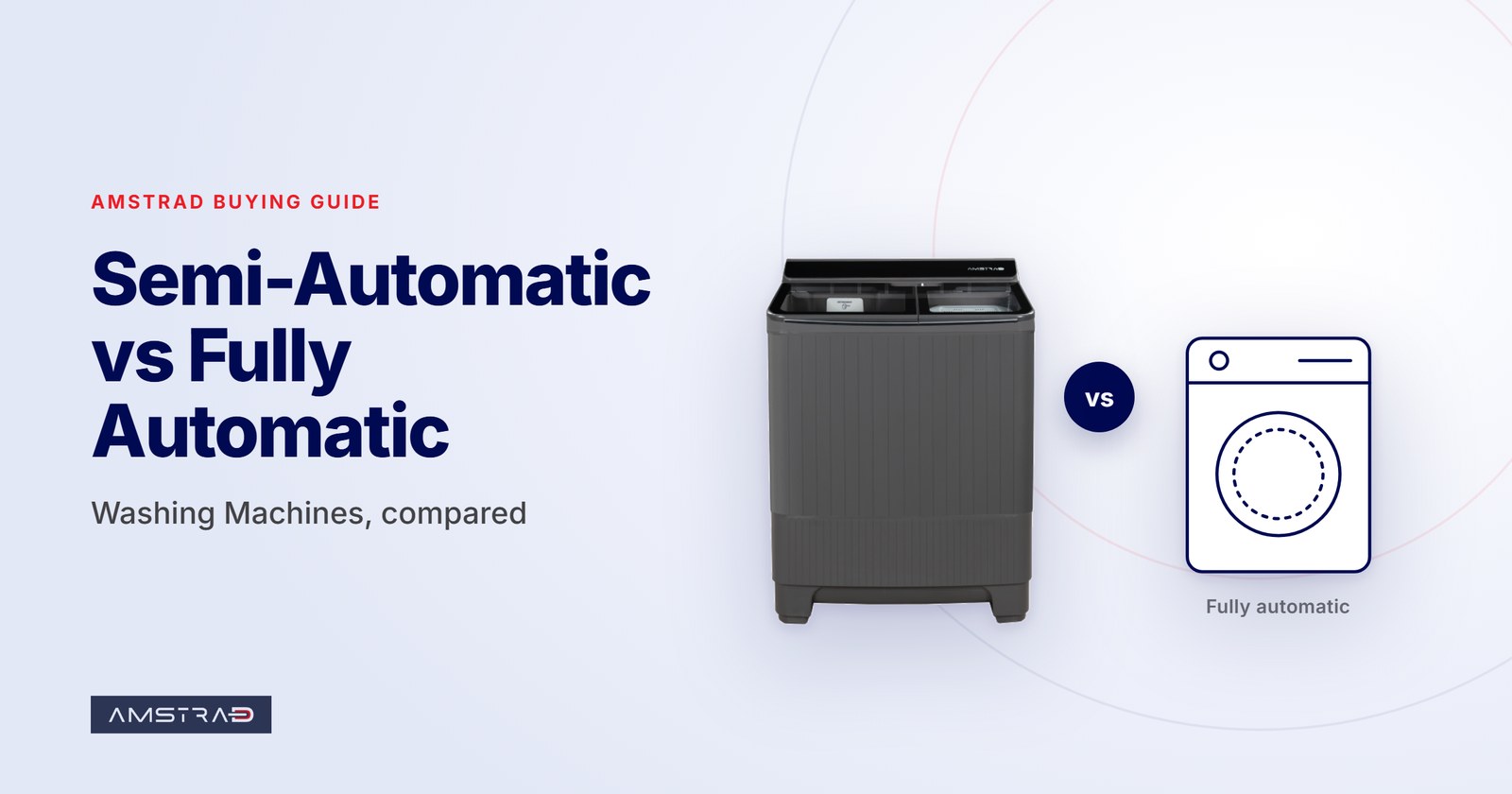
Both types wash clothes well. They differ in how much of the work the machine does for you, how much water they need and what they cost. Here is a clear comparison.
The short answer
Choose a semi-automatic Washing Machine if you want a lower price, have limited or low-pressure water supply, or wash large loads. Choose a fully automatic machine if you want to load the clothes and walk away.
Semi-automatic vs fully automatic at a glance
| Point | Semi-automatic | Fully automatic |
|---|---|---|
| Tubs | Two: one to wash, one to spin | One tub does everything |
| Your effort | You fill water and move clothes to the spin tub | Press start; the machine fills, washes, rinses and spins |
| Water supply | Can be filled by tap, hose or bucket | Needs a tap connection with steady pressure |
| Water use | Lower, and you control it | Higher, set by the programme |
| Wash time | Shorter cycles | Longer cycles |
| Purchase price | Lower | Higher |
| Moving the machine | Lighter, easy to shift | Heavier, usually fixed in one place |
How to use a Semi-Automatic Washing Machine
- Fill the wash tub with water to the level for your load and add detergent.
- Add the clothes and set the wash timer.
- Drain the soapy water, then rinse with fresh water.
- Move the clothes to the spin tub, close both lids and set the spin timer.
- Take the clothes out and hang them to finish drying.
Which capacity should you buy?
About 6 to 7 kg suits two or three people. 7.5 to 8.5 kg suits a family of four or five. Choose 9 kg or more for a larger family, or if you often wash bedsheets, blankets and curtains.
Explore the Amstrad range
See Amstrad Semi-Automatic Washing Machines from 7.5 kg to 14 kg.