

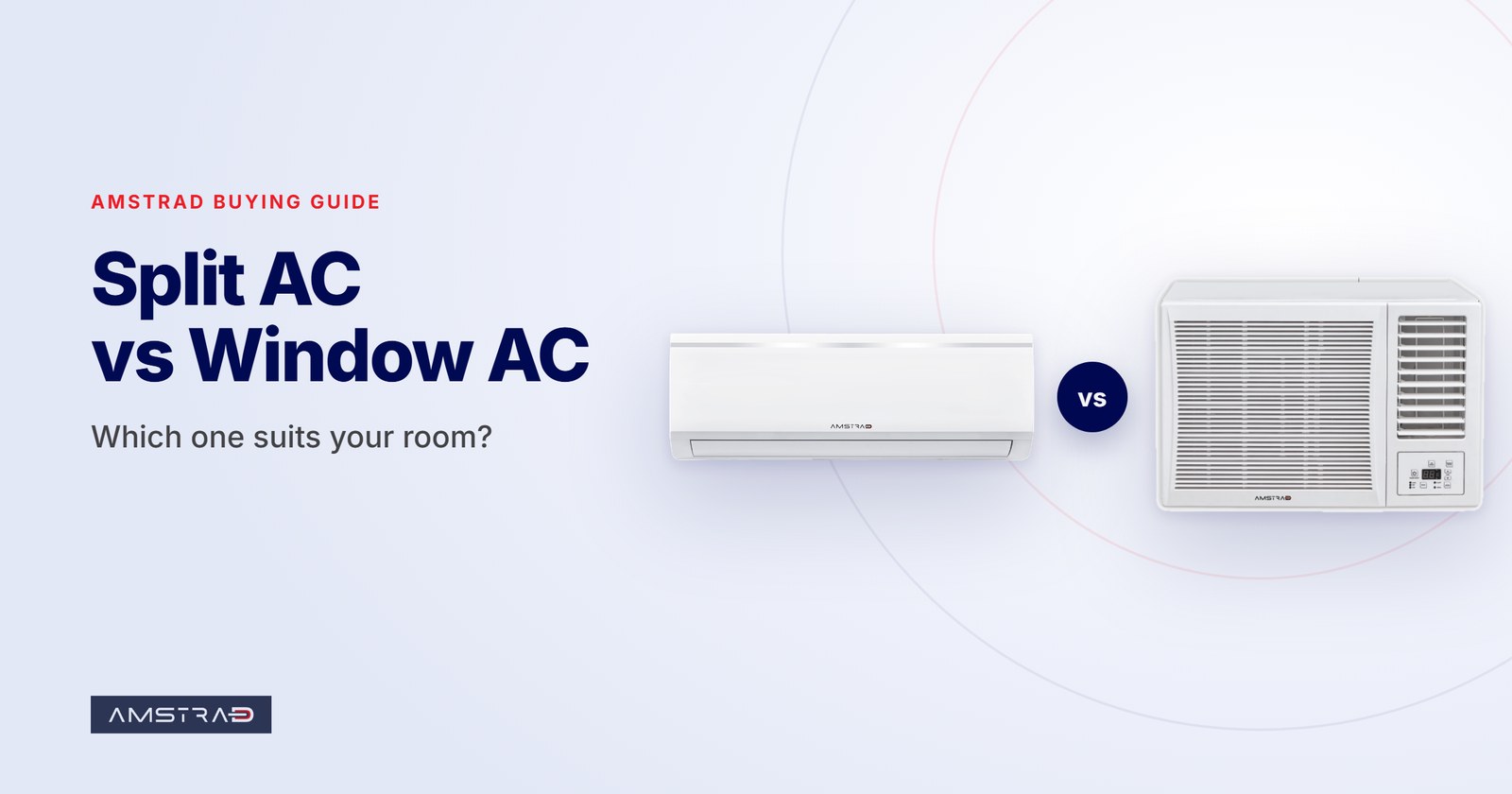
A split AC and a window AC cool a room in the same way. The difference is how they are built, and that changes the noise, the installation and the price. This guide compares the two so you can choose with confidence.
The short answer
Choose a split AC for a bedroom or living room where quiet matters, for rooms without a suitable window, and for larger rooms. Choose a window AC if you want a lower price, a simple installation, or you move home often.
Split AC vs window AC at a glance
| Point | Split AC | Window AC |
|---|---|---|
| Build | Indoor unit on the wall, compressor outdoors | One unit fitted in a window or wall opening |
| Noise in the room | Quieter, because the compressor is outside | Louder, because the compressor is in the same unit |
| Installation | Needs copper piping, drilling and an outdoor stand | Slides into a window frame, quicker to fit and remove |
| Sizes | 1 ton to 2.5 ton and above | Usually up to 1.5 or 2 ton |
| Looks and space | Keeps the window free | Blocks part of the window |
| Purchase price | Higher | Lower for the same tonnage |
| Shifting home | Needs a technician to remove and refit | Easy to take with you |
Which one uses less electricity?
Electricity use depends on the star rating and the compressor, not on whether the AC is a split or a window model. Compare the BEE star label and the yearly units printed on it. Inverter ACs, which are far more common among split models, use less power over long hours because the compressor slows down once the room is cool.
Which size do you need?
The same rule applies to both types. A 1 ton AC suits a room of up to about 120 sq ft, 1.5 ton suits 120 to 180 sq ft, and 2 ton suits 180 to 250 sq ft. Go one size up for top-floor rooms or rooms with strong afternoon sun.
Explore the Amstrad range
See Amstrad split ACs from 1 ton to 2.5 ton, or the Amstrad 1.5 ton window AC. For installation, raise a service request in any of six ways.